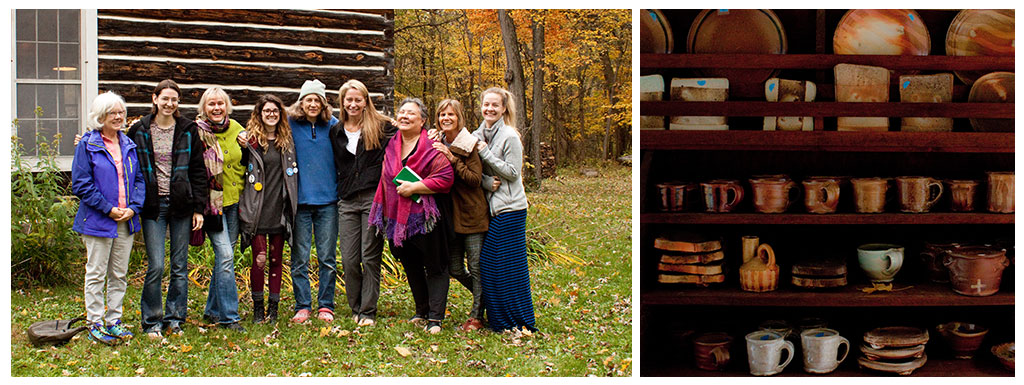
 We had a delightful trip out to Linda's studio. The leaves were gorgeous, and we couldn't have had a better day. Linda was as gracious and thoughtful as ever about the life and work of a potter.

Showing posts with label woodfire pottery. Show all posts
Showing posts with label woodfire pottery. Show all posts
Tuesday, October 13, 2015
Linda Christenson Studio Visit
We had a delightful trip out to Linda's studio. The leaves were gorgeous, and we couldn't have had a better day. Linda was as gracious and thoughtful as ever about the life and work of a potter.
Monday, March 9, 2015
RAM Press update by David Peters
This award has been a great honor and has provided the means for me to take new steps in my work. I am so thankful for the generosity of all who helped to make it possible for me and other artists like myself to take new steps in our research. Thank you to NCC and to all of the artists and professionals that have made the Warren MacKenzie Advancement Award happen. It is a great opportunity and I hope that it continues into the future.
The first part of my research funded by this grant was to learn the RAM press process in order to understand its potential to studio potters like myself. RAM press technology has been a popular production technique in industry for quite some time now, but has not been widely used in studio pottery. This is due to the fact that the press itself is a large capital investment, but also that the mold and die-making process is particularly involved. The strength of this process is that one can have a high production with relatively little physical effort. Also, unlike the slip casting method, one is not limited greatly by the type of clay one can use and this is a big plus for me as I am interested in local clay. I wanted to gain access to a press and learn die-making techniques before I invested in one so that I knew first hand if it was something that I wanted to pursue. With the help of this award, I traveled to Roberts, Wisconsin, and spent time with Mark Pharis.
Mark Pharis was generous enough to let me stay at his home, feed me, and teach me the basics from his own studio over the course of about two weeks and asked for nothing in return. I am honored that he was so willing to share his knowledge with me, and I am humbled by his generosity and example as a mentor. Thank you Mark for making me feel so welcome in your home and sharing your knowledge.
We chose a mortar and pestle as our project. This form is relatively simple, however the curvature of the interior of the mortar and the grinding end of the pestle needs to be fairly particular for it to grind efficiently. To do this by hand is quite time consuming so I felt this would be a great form to RAM Press. Likewise, Mark had never attempted to press two objects in the same die so it was a learning experience for both of us, and it proved to be quite challenging. Below are some photos following the basic process.
 |
First, a bisqueware prototype was sealed and waxed and then placed on a level surface inside a spacer ring. A trough was formed out of oil based clay around the perimeter of the separation lines on the objects and then clay was used to create a smooth transition from the edge of the trough to the rim of the spacer ring die.
|
 |
RAM press molds use a system of compressed air to purge the pressed object from the interior of the mold. To achieve this, a structure of wire mesh and cotton tubing is formed to be one inch from the object being cast. This was not particularly difficult but it did take a good deal of time.
|
 |
After the tubing system has been secured and connected to the die ring a high-strength plaster is poured. This is different than pouring a normal plaster mold in that the mixing of the plaster must be done in a very particular way. The plaster is slaked and then mixed for a very specific period of time. Then a small amount is placed in a cup and a thermometer is placed in the plaster. When the temperature of the plaster reaches a particular temperature you are ready to pour.
|
 |
Once the plaster is poured and just begins to set, a steel bar that has been machined to be perfectly flat is used to scrape off the back of the mold so that it meets the surface of the press evenly. If it does not sit perfectly flat, the extreme pressure of the hydraulic press will break the plaster during production.
|
 |
The temperature of the plaster is continuously monitored until it reaches the optimal temperature for purging. Here the die is connected to an air compressor and air is introduced into the plaster. Starting at 10psi, the pressure is increased incrementally as the plaster continues to set. This process creates porosity in the plaster, allowing air to travel through it, and thus allowing the object to be purged from the mold with compressed air during production.
|
 |
Once the first half of the mold is purged it is turned over and the spacer ring is registered back onto it. This ring creates space for excess clay to be expelled from the mold while pressing. However the two halves of the mold have to be registered perfectly, so this ring has registering holes and pins.
|
 |
Again, a trough made of oil clay is formed around the rim of the objects being pressed. This trough creates a space for the excess clay to collect as the object is being pressed. This collection also produces back pressure into the object as well, making sure that the entire negative space of the mold is evenly filled by clay. Clay is then used to create a smooth transition to the edge of the spacer ring.
|
 |
Again the tubing system is formed and suspended inside the die and the plaster pouring sequence is then repeated
for the other side of the mold.
|
 |
| While the first side of the mold went smoothly, the second half proved to be very challenging. The deep recess of the mortar broke off inside the original while being purged with compressed air and had to be removed with a chisel. |
 |
The same thing happened a second time and we had to really think out what was going wrong. This proved to be a great thing for me to witness for a couple of reasons. First, I learned that in this process you cannot even begin to flirt with undercuts. In order for the molds to release from the original, they must be rather open. This gave me great insight into how I will have to use the process to make certain forms. Second, I really saw just how frustrating making the molds can be. The system is not that complicated, but certain aspects of the mold have to be absolutely perfect and if you screw up you have to start over. Since the tubing system is so time-consuming, your patience is deeply tested.
|
 |
| Finally we got the second half of the mold to come out and we were ready for the fun part. |
 |
The mold is attached to the hydraulic press and the two sides are set to press together very close, but not touching. This allows for excess clay to escape the mold. Once the mold is in place, a lump of clay, which is measured to be in excess of the needed amount for the object, is laid in the bottom section of the mold and the press is engaged.
|
 |
Compressed air is passed through the bottom mold and the press is opened with the object clinging to the top section of the mold. Air is then passed through the top mold and the object is released into your hand or onto a ware board.
|
 |
The rope of clay, produced by the trough in the mold, is released along with the object and is then removed from the pot. This leaves a deckled edge that is usually removed, but I found it interesting and chose to leave it, showing a record of how the object was made.
|
 |
Here is when the power of the RAM press shows. I pressed 75 mortar and pestles in about 2 hours total. To make this many by hand would have taken me at least two weeks, if not more.
|
This process is deeply involved for sure. It takes a great deal of equipment and a lot of patience, but it also has a huge amount of potential. After learning the basics I could begin to see what could be done with it. One can press objects out of very stiff clay having the objects come out of the mold basically ready for the kiln. In contrast, very wet clay could be used and the forms could be manipulated by hand after pressing. While you are limited to only pressing objects that can be made from two-part molds, objects could be pressed in sections and joined. For example, a closed bottle form could be made by joining two pressed halves of the object, or more basic forms could be utilized as elements for handbuilding.
I have had a few conversations with people who are confused by my interest in this process. To them it seems to not fit in with the wood-fired, local clay process that I developed. To me, I do not see a problem; instead, I see great potential. With the rest of my process being so physically taxing, having a way to make quality forms quickly might mean the difference with being able to maintain the local clay woodfire aspect of my work or not. Besides the production aspect, I think it creates some interesting questions for my work at a time when I am ready for them.
I am very excited about what I have learned so far and I am in the process of finding a used RAM press, while scheming plans to finance it. I think my personality fits the process well. I love the designing of form and problem solving, but don't always relish repetitive production in the studio. I feel a sense of relief that I could reduce some wear and tear on my body, and I am excited about where the process might lead me in the future. Thank you for your interest!
Thursday, July 3, 2014
About David Peters

David is looking to identify ways in which he can sustain himself as a maker, given the reality of his current process which involve local materials and wood-firing, both of which are time consuming and physically taxing. David proposed to research new methods that would enable him to streamline parts of his making process, which includes the experimentation with the use of 3-dimensional CAD programs to help virtually load kilns (to maximize loading), as well as other technologies.
Throughout his grant year, David will travel to two artists' studios to learn their particular means of employing technology into production methods. David has plans to work with potter Mark Pharis of Roberts, WI (who uses RAM press technology) and potter Forrest Lesch Middelton of the Bay area, California (who uses a pug mill extruder). David recently received his graduate degree from Montana State University at Bozeman.
Throughout his grant year, David will travel to two artists' studios to learn their particular means of employing technology into production methods. David has plans to work with potter Mark Pharis of Roberts, WI (who uses RAM press technology) and potter Forrest Lesch Middelton of the Bay area, California (who uses a pug mill extruder). David recently received his graduate degree from Montana State University at Bozeman.
Subscribe to:
Posts (Atom)