 The exhibition Ideal Made Real: MN NICE is up in the Vine Arts Gallery through April 8, 2019. The show features the work of program Alumni and Affiliate Artists and celebrates MN NICE’s fifth anniversary. The exhibition is on display during Claytopia, the 2019 National Council on Education for the Ceramic Arts (NCECA) Conference held in Minneapolis.
Showing posts with label ceramics. Show all posts
Showing posts with label ceramics. Show all posts
Saturday, March 9, 2019
"Ideal Made Real" Exhibition!
The exhibition Ideal Made Real: MN NICE is up in the Vine Arts Gallery through April 8, 2019. The show features the work of program Alumni and Affiliate Artists and celebrates MN NICE’s fifth anniversary. The exhibition is on display during Claytopia, the 2019 National Council on Education for the Ceramic Arts (NCECA) Conference held in Minneapolis. Tuesday, March 5, 2019
Installing

MN NICE alumni worked hard this week to install their stunning exhibition at the Vine Arts Center Gallery. They transformed the space! The exhibition highlights work from program graduates as well the work of Affiliate Artists who mentor students throughout the year.
Sunday, September 10, 2017
Matters of Taste - The Universal Flavors Collection
 |
| Molds filled with colored Royal Copenhagen casting slip |
 |
| Drying forms in molds |
 |
| A variety of cast forms awaiting the bisque |
 |
| I cast each form multiple times in casting slip colored with Mason Stains |
 |
| Bird's eye view of mango, orange, and yellow dishes |
 |
| The residents arranged flavor form combinations |
 | |
| It was an unexpected treat to see the multitude of combinations created by the artists. |
 |
| Bitter |
 |
| Umami |
 |
| Sweet |
 |
| Sour |
 | |
| Salty |
Sunday, July 30, 2017
Exploring Local Design
INTRODUCTION
Denmark has a rich intellectual and
artistic heritage. The Danes are a happy and proud people and have a special
relationship with their country and their flag. The Danish flag is everywhere
and has a name: “dannebrog”, which means “Danish cloth”. Legend has it that the
flag fell from the sky during a battle of the Danish army against Estonia, when
they were praying to God to save them from defeat – which worked. I think it’s
a quite pretty flag. Its bold red and white colors look great on the background
of a clear blue sky. Equally as important to Danish culture is the country’s
arts and crafts. Danish artistic sensitivity spans into everyday life
transforming architecture, furnishings, tableware, décor, and textiles that
become functional art objects.
DESIGN MUSEUM DENMARK
A visit to the Design Museum in Copenhagen
provided an extensive look into the last century of Danish design. Of
particular interest was a permanent exhibition entitled The Danish Chair, an International Affair. A diverse collection of
chairs told the story of how Danish Modern became an international brand and
trendsetting trailblazer. A stunning display of 100 Danish and international
chairs line a hexagon-shaped room from floor to ceiling. Each chair is framed
in its own clean white box, shown as a series of individual art objects. An
homage to domestic design and craftsmanship, the exhibition emphasized
1920-1970, the pinnacle of Danish furniture design. Materials including wood,
plastic, metal, and fabric make up a variety of chair styles such as armchairs,
dining room chairs, folding chairs, lounge chairs, and rocking chairs. The
design and fabrication of each chair was inspiring, yet gained a greater
context and presence displayed as a collection. It staged a look into how design
trends changed over the years and the many approaches to the modern chair in
the 20th century.
“The chair is the piece of furniture that is closest to human
beings. It touches and reflects the body that sits on it, with arms, legs, seat
and back. It is a designer's touchstone and design history's favorite object.
And the chair is one of the most culture-bearing design objects.” (Nikolina
Olsen-Rule)
Journeying to the other side of the world without leaving the
museum, the exhibition Learning from
Japan, highlights the connection of Japanese art as a continued source of
inspiration for Danish arts and crafts. Japanism has been a catalyst and
important precursor to the modern Danish aesthetic that branded Denmark into a
design nation in the 20th century. The exhibition includes 400 works
of furniture, ceramics, painting and woodblock prints, textiles, sculptures and
lamps. The idea for the exhibition is based on the book, “Influences from Japan
in Danish Art and Design 1870-2010,” by exhibition curator and art historian
Dr. Phil Mirjam Gelfer-Jorgensen. Inspired by elements of nature, intentional
design, and quality craftsmanship, the connections between the two cultures are
long-lasting and surprising. A shared commitment to form following function,
simple lines, and timeless style in elegance, make apparent the thematic
threads that tie these two design icons together. The strongest relationship I
observed was both countrys’ belief in the beauty of things to make life better.
From this concept stems the source for the aesthetic correlations brought to
light by the exhibition’s juxtaposition of these two cultures.
DOMESTIC DESIGN
Scandinavian design and its famed art objects are not bonded to
the artistic institution in Denmark. Examples of Danish style can be seen in
everyday architecture and décor, especially within domestic spaces. Described
as being fairly minimalist with clean lines, Danish design is highly functional
with effective style that is devoid of heavy elements. Only what is needed is
used. Deriving this philosophy from inter-war art movements, Scandinavian
design is sometimes referred to as democratic design, because of its aim to
appeal to the masses through products that are accessible and affordable.
However, in an effort to achieve balance, the designs were not stripped of
their beauty to make them as easy to use as possible. This theme and continued
examples of Scandinavian design where visible as I explored Copenhagen and
Skaelskor. The studio and resident house were inspiring specimens of the country’s
design sensibilities and histories. Being immersed in these spaces for six
weeks had a profound effect on the designs for my ceramic work. Designing
through experience and observation seemed effortless when surrounded by
constant examples of good design and timeless beauty.

The Danish Flag is hung for national holidays and special events.
 |
| Japanese Textile, Design Museum, Denmark |
 |
 |
 |
 |
| Permanent Collection, Design Museum, Denmark |
 |
| The Danish Chair, An International Affair, Design Museum, Denmark |
 |
| The Danish Chair, An International Affair, Design Museum, Denmark |
 |
| The Danish Chair, An International Affair, Design Museum, Denmark |
 |
| Kitchen, Guldagergaard Resident House |
 |
| Living Space, Guldagergaard Resident House |
 |
| Library, Guldagergaard Resident House |
Sunday, June 25, 2017
2017 Warren Mackenzie Advancement Award: Residents in the Kitchen
INTRODUCTION
In everyday life food
is never presented or served in isolation. Food is always placed in a container
either disposable-like packaging or indispensable such as a plate or a bowl. My
investigation of plating and platewares has led me to a residency at Guldegargaard International Ceramic Research Center in Skaelskor, Denmark. I started my research investigating the
formal elements of dishware, such as color, size and shape that psychologically
influence the way in which food is perceived. This commonly neglected element
of a meal can affect everything from how we perceive the taste of food to how
much we eat. Of particular interest are the socially constructed notions of the
likely
taste and flavor of foods contained in ceramic wares.
taste and flavor of foods contained in ceramic wares.
SIZE MATTERS
- Size, Shape, and color have an effect on the flavor perception of food.
- Blue = salty
- Red = Sweet
- Green = sourness
- People are happier with smaller portions off of a blue plate
- Color contrast illusion – look it up, grapes look redder on a blue plate
- Plate = background (could this be foregrounded?)
- White is best for dessert plates.
- Law of opposites, round food needs a square or rectangular plate
- Aesthetic choices can inform how the diner responds to the dish
THE PROJECT
I choose Guldegargaard for the opportunity to work with an
international population of artists that have an appreciation for the hand and
the acceptance of the individual elements in life, both in living and making. As
well as for the evening meal rota they practice there. The residents of Guldagergaard take turns cooking a
family meal each night. I planned to use the evening meal rota as research and
development to document shared meals from different cultures. Each day creating
a food memory drawing composition inspired by a dish or ingredient from the
last night’s meal. The formal elements of the drawings will inform visual
connections between the basic flavors of a meal and individual flavor
experiences. I look forward to being inspired by new people, familiar and
foreign flavors, and fresh possibilities.
This
research will inform the design and fabrication of five slip-casting molds. The
forms will be a line, or related series of individual ceramic pieces. This line
of functional tableware will be intimate in scale, suitable for one or two
person utility. Asymmetry and clean lines will characterize the resulting
forms. From a mind and mouth perspective I will interpret the five universally
recognized basic tastes – sweet, sour, bitter, salty, and umami (savory).
Through form, color and texture I will visually translate these biological
flavor perceptions into sensorial ceramic objects.
 |
| A scene from Copenhagen, Denmark. Copenhagen is historically a maritime city and harbor. The residency is two trains, a bus ride, and short walk to the resident house in Skaelskor, Denmark from the Copenhagen Airport. |
 |
| Skaelskor, Denmark is home to the residency as well as loads of wide open spaces. It is the perfect destination for peaceful respite from fast paced city life and uninterrupted studio time for creative development. |
 |
| This is Guldagergaard International Ceramic Research Center. The studio use to be a farmhouse for a fruit orchard. The ceramic residency is celebrating its 20 year anniversary in July. |
 |
| There is typical 6 to 13 residents and staff living and working there at one time. The stay duration range greatly and artists come and go on individual schedules. It also seemed a common trend to extend the stay time. I stayed an extra half a week, and this figure sculptor from New Zealand, Jim Cooper, came for a 6 week residency last September and has stayed for eight months. The studio manager calls Guldagergaard the "Health Farm" because its such a quiet and restful place, and the residents are taken care of and well feed. |
 |
| One of the main reasons I choose this residency out of all the wonderful international options for residencies is the evening meal rota the residents participate in. Each night the residents take turns cooking for the whole house. Meaning that about once a week I took time off from studio for half a day to make a large family meal for dinner. As much of my form research is food focused, I decided to use these meals as an avenue for research. |
 |
| I wanted to investigate the relationship between plating and plateware on the multisensory perception of food. I used the evening meal rota as research and development to document shared meals from different cultures. |
 |
| The morning after each meal I would create a quick food memory drawing using the visual and sensorial elements of a particular dish from the night before. The formal elements of the drawings will then informed visual connections between the basic flavors of a meal and individual flavor experiences. This drawing was meant to capture a Danish delicacy Sister Bread made with beer. Sweet and grainy characterizes its flavors. |
 |
| This drawing was inspired by a black rice, sweet potato, and ginger dish made my Joe, a Chicago native artist. |
 |
| A memory of cucumber salad with pomegranate and mint. The early drawings captured more representation elements based on the color and shape of the food. The later drawings became more abstract. |
 |
| A memory of a nut loaf bread made by Danish Artist Dorte. She had the most interested baking methodology I have ever seen. She threw ingredients together in a large mixing bowl relying only on instinct of a recipe that had been made time and again. There was no measuring or concern for proper dissolving of the yeast. The resulting bread was perfectly soft and fluffy; it tasted earthy, round, bold, and savory for the myriad of nuts in it. |
 |
| Traditional ancient nut and seed bread. This Danish delight is made without any flour which yields an incredibly dense yet thinly sliced bread. The Danes are wild about their baked goods. |
 |
| Each day my collect of food memories grew and I posted them in my studio space to influence the formal elements of dishware, such as color, size and shape that psychologically influence the way in which food is perceived. |
A former orchard, Guldegargaard is
celebrating its Twentieth Anniversary this year. The land surrounding the
residency is a vast municipal park and often town’s people walking by peak
their heads in the studio to see what’s being made. The town of Skaelskor is a
quaint seaside town in the Slagelse municipality on the Danish island of
Zealand. The town has a population of 6,532. And is home to one of Denmark's
largest breweries, the Harboe Brewery. Some days the wind would shift and the
whole town smelled like brewing hops.
WORKS CITED
Saturday, May 6, 2017
Made Here MN
 Brenda Ryan, a 2016 MN NICE graduate, took part in Made Here MN, a project of Hennepin Theater Trust that temporarily exhibits the work of Minnesota Artists in empty storefronts. Brenda filled the window with a tree, cut stumps, and an amazing trompe l'oeil saw that grew out of her class materials research project into adobe and paper clay.
Monday, January 9, 2017
Patrick Kingshill WMAA presentation
2016 Warren MacKenzie Advancement Awardee Patrick Kingshill, presents outcomes from his trip to Jingdezhen.
You can download a pdf of Patrick's slide show here: Kingshill Jingdezhen Presentation
The WMAA, founded in 2014, provides an opportunity for students and emerging artists to continue their ceramic research and education for a period of up to twelve consecutive months within the grant year, further expanding their professional development.
You can download a pdf of Patrick's slide show here: Kingshill Jingdezhen Presentation
The WMAA, founded in 2014, provides an opportunity for students and emerging artists to continue their ceramic research and education for a period of up to twelve consecutive months within the grant year, further expanding their professional development.
Wednesday, April 15, 2015
Update from Kevin Kao - MFA Thesis
 |
| "Fallacies" MFA Exhibition, May 2015 |
Hello! Its been a busy year thus far. The majority of my focus has been on creating my thesis exhibition. Much of the show looks at a structured sense of seduction and desire. Specifically looking at how attraction is an extension of how we perceive our bodies. These ideas really stemmed from some of the hair studies that I had created while at Alfred's studio intensive program last summer. Thank you for the support of the Warren MacKenzie Advancement Award and all of the donors who have made this possible.
 |
| Hair Bun Studies |
 |
| Plop, a part-made study |
 |
| Terra Cotta hair study |
I think of hair as both something beautiful and grotesque, but above all, a quality that describes every single person. It's intrinsically you, as detritus and as hairstyle. Throughout history, it has been a marker for style, taste, value, and social class. The notion of part-making and interchangeable parts became an important factor as it draws from a history of Chinese ceramics (e.g. the terracotta army). It speaks to the significance of individuality, the hand-made, and the specialness of an object.
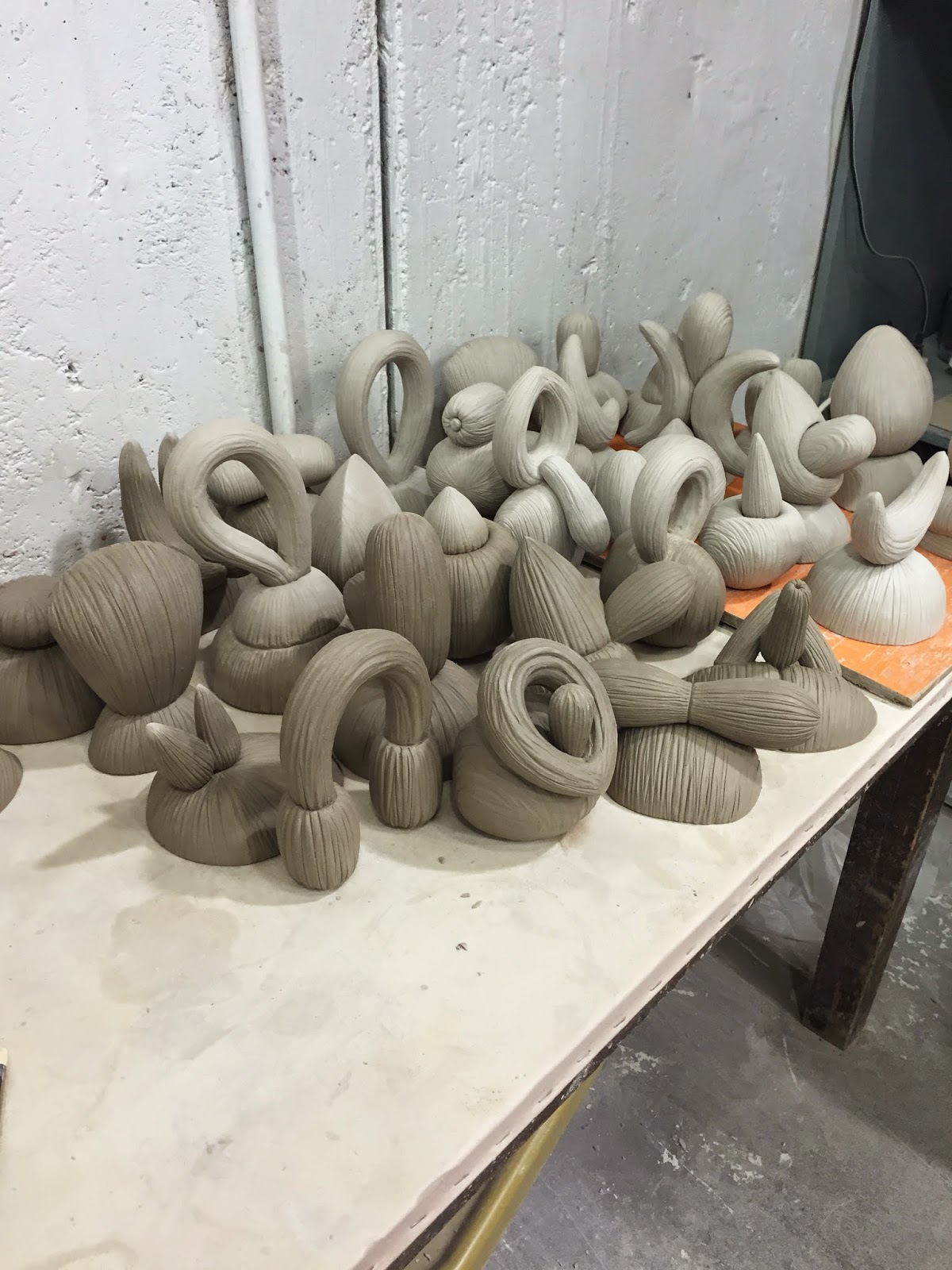 |
| Press-molded works in progress |


I think of the project as a way of looking at the individual and the collective. On one hand, the individuality gives meaning to one thing — its history, its context. However, against the sea of other objects, it loses its uniqueness to seriality. The collection negates, and absorbs the individual.


Reinforcing this idea of seduction, the 104 ceramic sculptures are ambiguously hair, fruit and sex-toy. These "objects of lust" are rendered on a mirror-like platform, set close to the ground. A play on black on black, the sensualness of the work is hyper-accentuated.
For more information about the show or my work, please visit my website: www.kevinrkao.com
Monday, March 9, 2015
RAM Press update by David Peters
This award has been a great honor and has provided the means for me to take new steps in my work. I am so thankful for the generosity of all who helped to make it possible for me and other artists like myself to take new steps in our research. Thank you to NCC and to all of the artists and professionals that have made the Warren MacKenzie Advancement Award happen. It is a great opportunity and I hope that it continues into the future.
The first part of my research funded by this grant was to learn the RAM press process in order to understand its potential to studio potters like myself. RAM press technology has been a popular production technique in industry for quite some time now, but has not been widely used in studio pottery. This is due to the fact that the press itself is a large capital investment, but also that the mold and die-making process is particularly involved. The strength of this process is that one can have a high production with relatively little physical effort. Also, unlike the slip casting method, one is not limited greatly by the type of clay one can use and this is a big plus for me as I am interested in local clay. I wanted to gain access to a press and learn die-making techniques before I invested in one so that I knew first hand if it was something that I wanted to pursue. With the help of this award, I traveled to Roberts, Wisconsin, and spent time with Mark Pharis.
Mark Pharis was generous enough to let me stay at his home, feed me, and teach me the basics from his own studio over the course of about two weeks and asked for nothing in return. I am honored that he was so willing to share his knowledge with me, and I am humbled by his generosity and example as a mentor. Thank you Mark for making me feel so welcome in your home and sharing your knowledge.
We chose a mortar and pestle as our project. This form is relatively simple, however the curvature of the interior of the mortar and the grinding end of the pestle needs to be fairly particular for it to grind efficiently. To do this by hand is quite time consuming so I felt this would be a great form to RAM Press. Likewise, Mark had never attempted to press two objects in the same die so it was a learning experience for both of us, and it proved to be quite challenging. Below are some photos following the basic process.
 |
First, a bisqueware prototype was sealed and waxed and then placed on a level surface inside a spacer ring. A trough was formed out of oil based clay around the perimeter of the separation lines on the objects and then clay was used to create a smooth transition from the edge of the trough to the rim of the spacer ring die.
|
 |
RAM press molds use a system of compressed air to purge the pressed object from the interior of the mold. To achieve this, a structure of wire mesh and cotton tubing is formed to be one inch from the object being cast. This was not particularly difficult but it did take a good deal of time.
|
 |
After the tubing system has been secured and connected to the die ring a high-strength plaster is poured. This is different than pouring a normal plaster mold in that the mixing of the plaster must be done in a very particular way. The plaster is slaked and then mixed for a very specific period of time. Then a small amount is placed in a cup and a thermometer is placed in the plaster. When the temperature of the plaster reaches a particular temperature you are ready to pour.
|
 |
Once the plaster is poured and just begins to set, a steel bar that has been machined to be perfectly flat is used to scrape off the back of the mold so that it meets the surface of the press evenly. If it does not sit perfectly flat, the extreme pressure of the hydraulic press will break the plaster during production.
|
 |
The temperature of the plaster is continuously monitored until it reaches the optimal temperature for purging. Here the die is connected to an air compressor and air is introduced into the plaster. Starting at 10psi, the pressure is increased incrementally as the plaster continues to set. This process creates porosity in the plaster, allowing air to travel through it, and thus allowing the object to be purged from the mold with compressed air during production.
|
 |
Once the first half of the mold is purged it is turned over and the spacer ring is registered back onto it. This ring creates space for excess clay to be expelled from the mold while pressing. However the two halves of the mold have to be registered perfectly, so this ring has registering holes and pins.
|
 |
Again, a trough made of oil clay is formed around the rim of the objects being pressed. This trough creates a space for the excess clay to collect as the object is being pressed. This collection also produces back pressure into the object as well, making sure that the entire negative space of the mold is evenly filled by clay. Clay is then used to create a smooth transition to the edge of the spacer ring.
|
 |
Again the tubing system is formed and suspended inside the die and the plaster pouring sequence is then repeated
for the other side of the mold.
|
 |
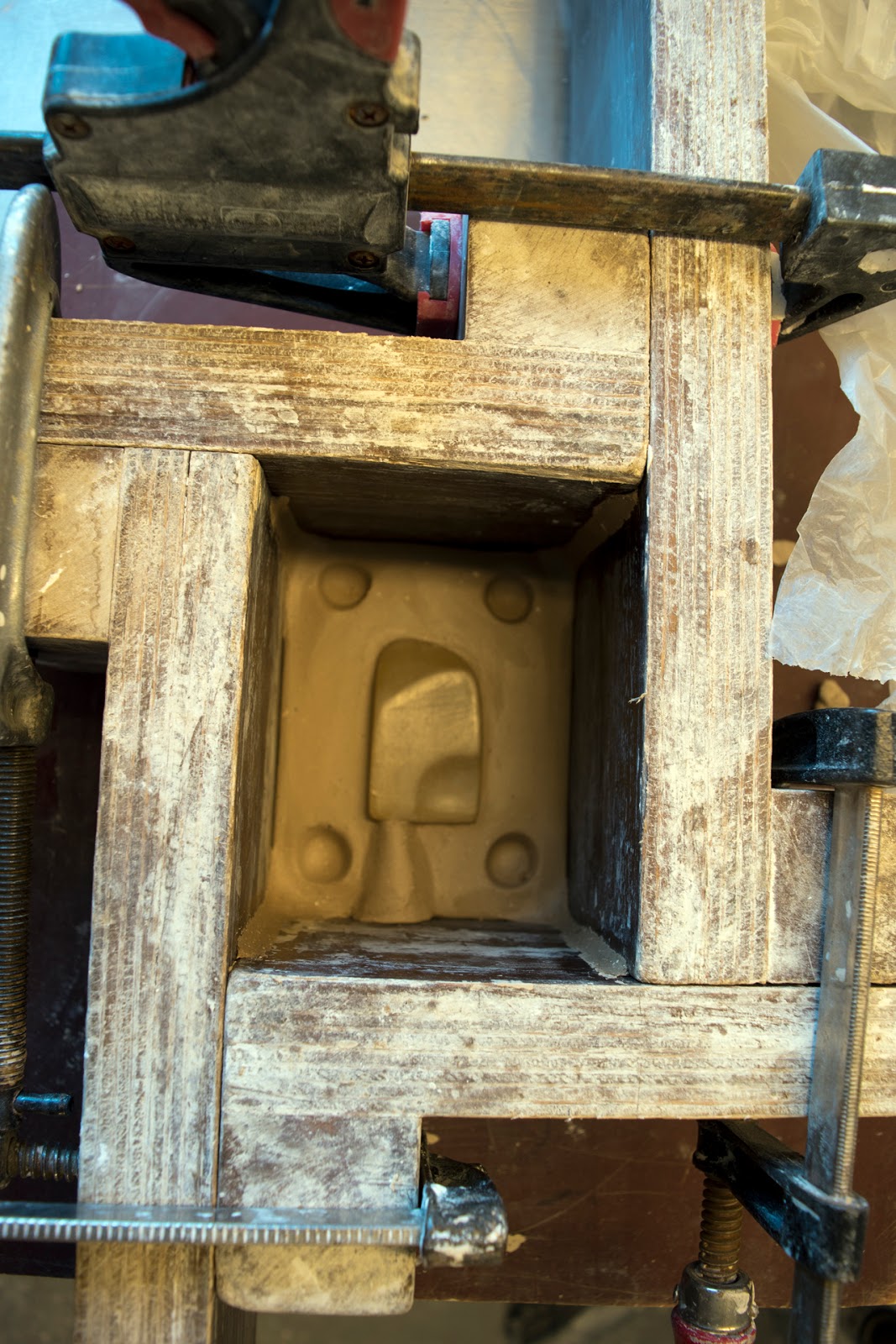
| While the first side of the mold went smoothly, the second half proved to be very challenging. The deep recess of the mortar broke off inside the original while being purged with compressed air and had to be removed with a chisel. |
 |
The same thing happened a second time and we had to really think out what was going wrong. This proved to be a great thing for me to witness for a couple of reasons. First, I learned that in this process you cannot even begin to flirt with undercuts. In order for the molds to release from the original, they must be rather open. This gave me great insight into how I will have to use the process to make certain forms. Second, I really saw just how frustrating making the molds can be. The system is not that complicated, but certain aspects of the mold have to be absolutely perfect and if you screw up you have to start over. Since the tubing system is so time-consuming, your patience is deeply tested.
|
 |
| Finally we got the second half of the mold to come out and we were ready for the fun part. |
 |
The mold is attached to the hydraulic press and the two sides are set to press together very close, but not touching. This allows for excess clay to escape the mold. Once the mold is in place, a lump of clay, which is measured to be in excess of the needed amount for the object, is laid in the bottom section of the mold and the press is engaged.
|
 |
Compressed air is passed through the bottom mold and the press is opened with the object clinging to the top section of the mold. Air is then passed through the top mold and the object is released into your hand or onto a ware board.
|
 |
The rope of clay, produced by the trough in the mold, is released along with the object and is then removed from the pot. This leaves a deckled edge that is usually removed, but I found it interesting and chose to leave it, showing a record of how the object was made.
|
 |
Here is when the power of the RAM press shows. I pressed 75 mortar and pestles in about 2 hours total. To make this many by hand would have taken me at least two weeks, if not more.
|
This process is deeply involved for sure. It takes a great deal of equipment and a lot of patience, but it also has a huge amount of potential. After learning the basics I could begin to see what could be done with it. One can press objects out of very stiff clay having the objects come out of the mold basically ready for the kiln. In contrast, very wet clay could be used and the forms could be manipulated by hand after pressing. While you are limited to only pressing objects that can be made from two-part molds, objects could be pressed in sections and joined. For example, a closed bottle form could be made by joining two pressed halves of the object, or more basic forms could be utilized as elements for handbuilding.
I have had a few conversations with people who are confused by my interest in this process. To them it seems to not fit in with the wood-fired, local clay process that I developed. To me, I do not see a problem; instead, I see great potential. With the rest of my process being so physically taxing, having a way to make quality forms quickly might mean the difference with being able to maintain the local clay woodfire aspect of my work or not. Besides the production aspect, I think it creates some interesting questions for my work at a time when I am ready for them.
I am very excited about what I have learned so far and I am in the process of finding a used RAM press, while scheming plans to finance it. I think my personality fits the process well. I love the designing of form and problem solving, but don't always relish repetitive production in the studio. I feel a sense of relief that I could reduce some wear and tear on my body, and I am excited about where the process might lead me in the future. Thank you for your interest!
Subscribe to:
Posts (Atom)